
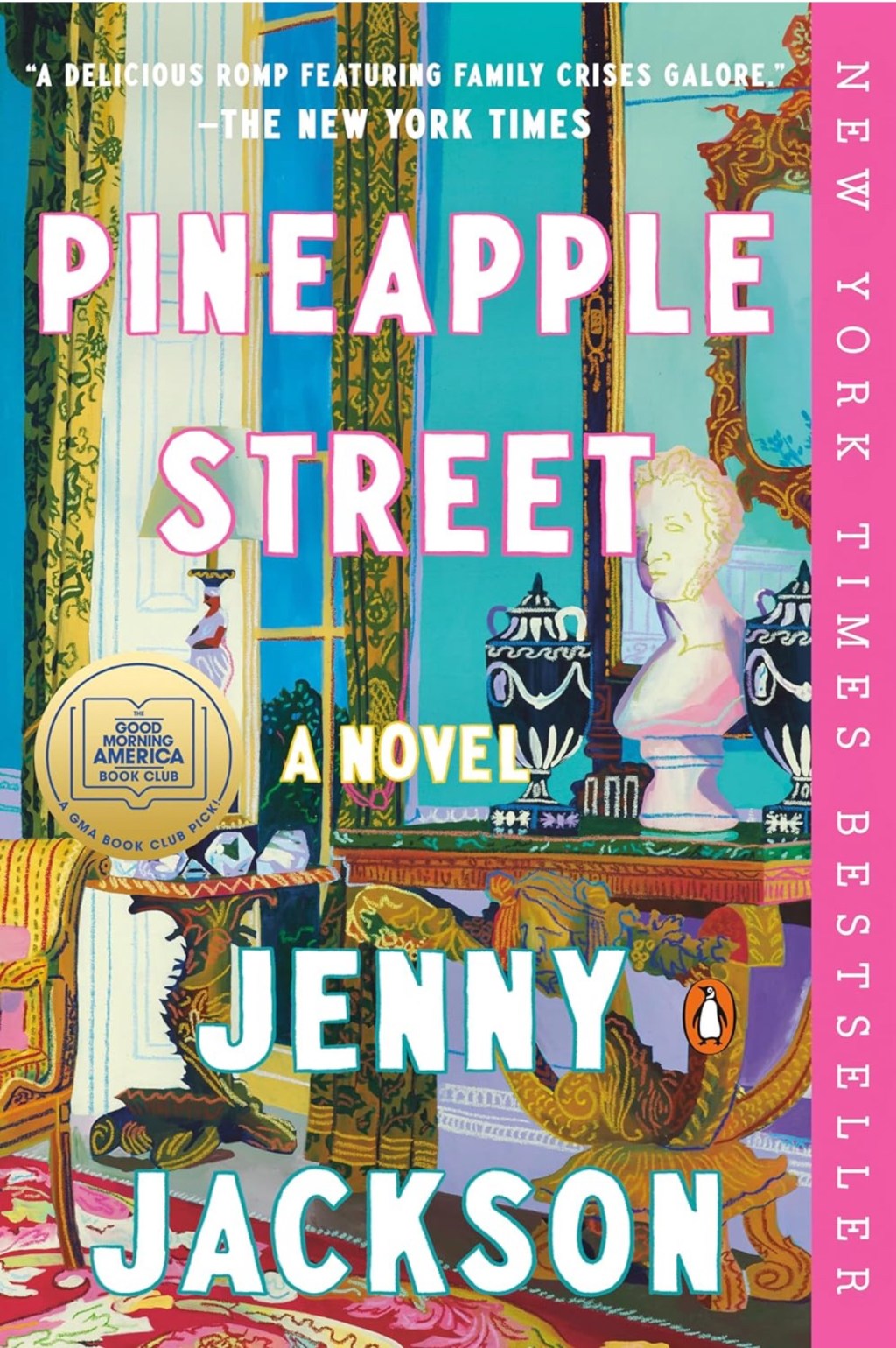
A Sharp, Satirical Peek into Brooklyn’s Most Buttoned-Up Brownstone
If you’re in the mood for a juicy, fast-paced novel that lets you play fly-on-the-wall in the world of old-money Brooklyn, then Jenny Jackson’s Pineapple Street is calling your name. It’s rich with dark humor, sparkling wit, and characters so well-drawn, you’ll feel like you’ve been invited to one of their overly formal family dinners—whether you want to be there or not.
At the heart of this delicious debut is the Stockton family, a legacy real estate clan that has long ruled over Brooklyn Heights from their perch on Pineapple Street. There’s Tilda, the stylish and stubborn matriarch whose idea of affection is a perfectly polished tablescape; Chip, her tennis-loving, money-managing husband who always keeps the trust funds flowing; and their three grown children: Darley, Georgiana, and Cord.
But it’s not just about who was born a Stockton—it’s also about who married into it.

Enter Sasha, the outsider. An artist from Rhode Island, Sasha finds herself adjusting to life in a grand Brooklyn brownstone after marrying Cord Stockton, the quiet brother who keeps the family finances humming. But Sasha’s transition into high society is far from smooth. Her sisters-in-law barely conceal their disdain, privately dubbing her a “gold digger,” and the welcome mat at family gatherings feels more like a trapdoor.
This quote, which hits early in the book, perfectly sums up the world Sasha’s trying to navigate:
“Her own family was a restaurant booth—you could always scoot in and make space for one more. Cord’s family was a table with chairs, and those chairs were bolted to the floor.”
That line stuck with me. It’s a stunning metaphor for how class, upbringing, and tradition create invisible lines that are hard to cross. Sasha might be married in, but she’ll never be able to scoot her chair closer to the table—not in the eyes of the Stockton women.
Let’s talk about those Stockton women for a moment. Jackson gives us three sharply drawn female protagonists, each dealing with her own form of reckoning inside this crumbling palace of inherited wealth.
Darley, the eldest, walked away from her trust fund and a high-powered career in finance to marry for love and raise two kids. But when her husband Malcolm gets laid off, Darley is forced to confront just how fragile her financial ideals really are. Her storyline is full of rich, layered tension—between love and money, independence and duty, pride and practicality. Oh, and her kids? Delightfully morbid. You’ll know what I mean when you get there.
Georgiana, the baby of the family, is privileged, well-meaning, and completely insulated from real-world consequences. She works at a nonprofit and is having an affair with her (married) boss, believing herself romantic and tragic rather than complicit and naive. Her journey is one of self-awareness slowly cracking through the surface of her spoiled worldview, and while she might frustrate you, you’ll root for her all the same.
And then there’s Sasha, arguably the heart of the novel. As an in-law, she’s constantly trying to decode the family’s silent rules and unspoken snubs. She’s misunderstood, underestimated, and often dismissed—but she’s also deeply self-aware, navigating the choppy waters of identity, ambition, and love in a world that wants her to stay in her (less expensive) lane. Watching her story unfold is like peeling back the layers of a very fancy cake—messier than it looks, but much more satisfying.
Jackson’s writing is electric—quick, observant, and laced with biting humor. She takes the time to explore how money changes people, how it insulates, isolates, and elevates—but never quite satisfies. You’ll find echoes of The White Lotus, Succession, and The Gilded Age, but this story belongs wholly to the women at its center. They are flawed, funny, and fascinating in all the best ways.

The themes—class, privilege, nepotism, generational wealth—could easily feel heavy, but Jackson balances them with comedy and heart. One of my favorite elements is how she skewers holiday traditions, competitive family games, and performative charity work with the kind of precision that feels both exaggerated and deeply real.
The only critique I have? I wanted more. The story wraps up a little too quickly, resolving some of the tension in a way that feels just shy of satisfying. I kept turning the last pages hoping there’d be a hidden epilogue tucked in the back cover. This world is so vivid, and these women so compelling, that a sequel feels not only possible—but necessary.
What I appreciated most about Pineapple Street is that it didn’t demonize the one percent for sport. Sure, you’ll roll your eyes at their quirks and gasp at their obliviousness, but you’ll also feel the pang of their loneliness, the ache of expectations, and the constant pressure to uphold a legacy that maybe no one asked for.
If you’re someone who enjoys a character-driven story with a voyeuristic peek into the upper crust—served with a dry martini and a side of dysfunction—this book is for you. It’s like a gossip column met a therapy session and then had brunch in a brownstone.

Final Thoughts:
Pineapple Street was one of my favorite reads this year—sharp, satirical, and unexpectedly moving. It’s a love letter and a roast to Brooklyn’s elite, told with flair, insight, and plenty of laugh-out-loud moments. I’ll be thinking about these characters for a long time and secretly hoping I bump into Sasha at a gallery opening someday. She deserves that second chapter.
Read it for: dysfunctional families, subtle burns, Brooklyn brownstones, and the joy of watching someone finally stand up at the table and pull out their own chair.
Happy Reading,
Love,
Emma
 EmmaCohan.com
You must be logged in to post a comment.